
What the Grand Traverse County Probate Court Handles
The Probate Court is one of the trial court divisions serving Grand Traverse County. It sits alongside the Circuit Court and the District Court, but its work is different. This court deals with wills, the estates of people who have died, and the care of people who cannot look after themselves or their money. Judge Jennifer L. Whitten presides over the combined Probate and Family Division.
The court's docket covers a defined set of subjects. Each one produces a case file, and most of those files become part of the public probate record. The following matters fall under Grand Traverse County probate jurisdiction.
- Decedent estates, meaning the property of a person who has died
- Wills and the safekeeping of an original will
- Guardianship of an adult, a minor, or a person with a developmental disability
- Conservatorship over a protected person's finances
- Trusts and trust supervision
- Involuntary treatment of a person with a mental illness
- Delayed registration of a foreign birth
The court does not run its own probation program. Questions about probation are routed to state parole and probation, District Court probation, or juvenile probation instead. The county's Probate Court page describes the office and links each of these subject areas to its own forms.
The court shares the justice campus with the county's other trial courts, and the county posts facility updates in its public news feed. That feed is the source of the image below.
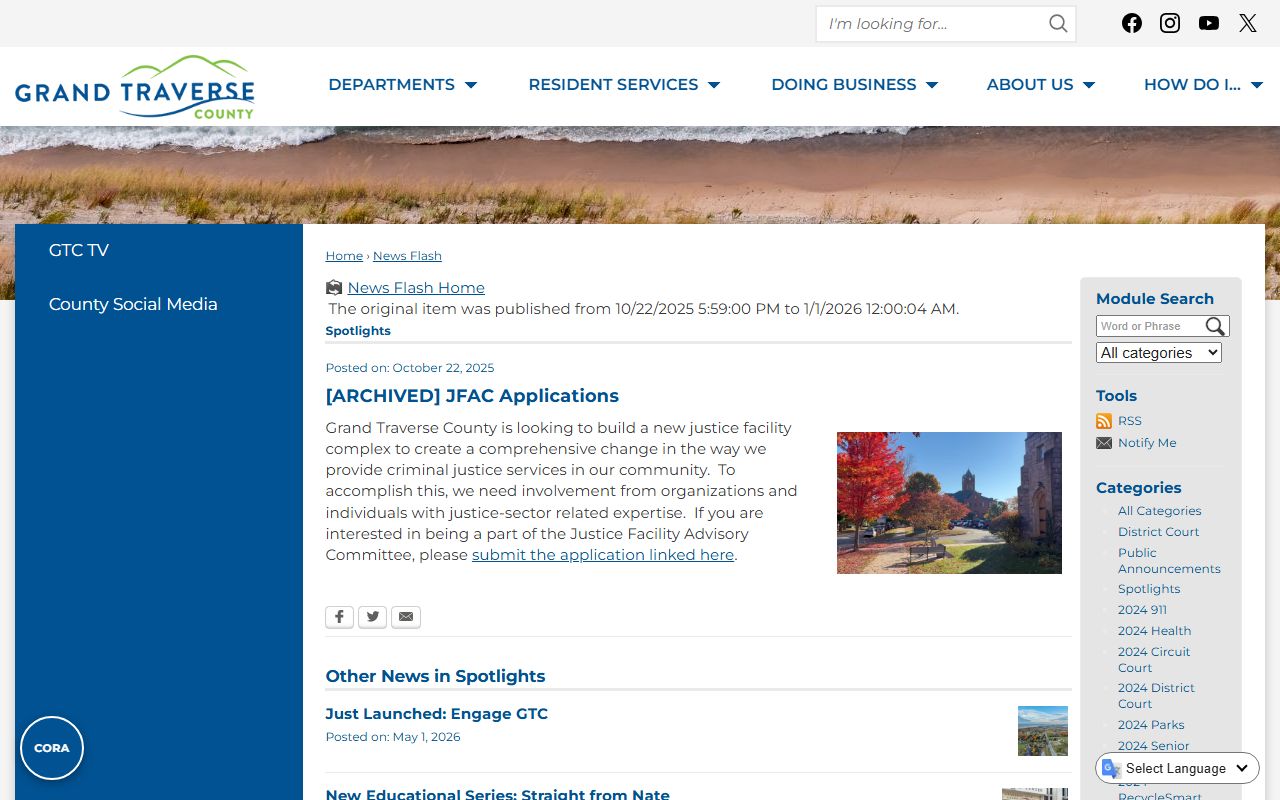
The archived notice points to work on the justice building that houses the Probate Court, so its hours and public counter can shift while projects are underway.
Grand Traverse County Probate Terms Defined
Probate uses words that rarely come up anywhere else. A quick glossary makes a Grand Traverse County probate records search easier to follow, since these terms appear on the case header and in the filed documents themselves.
- Testator
- The person who wrote and signed the will while alive.
- Personal representative
- The person the court appoints to gather assets, pay debts, and distribute an estate. Michigan uses this term where older law said executor or administrator.
- Intestate
- Dying without a valid will, so state law decides who inherits.
- Letters of authority
- The court paper that proves a personal representative has the power to act for the estate.
- Guardianship
- Court authority over the personal care and decisions of a minor or an incapacitated adult.
- Conservatorship
- Court authority over the money and property of a protected person.
Grand Traverse County Probate Court Contact
Probate is handled in person, by mail, and by fax at a single county office. The counter stays open through the lunch hour, which helps people who can only visit midday. ADA accommodations run through coordinator Amanda Flowers at the same phone number.
Grand Traverse County Probate Court
280 Washington Street, Suite 223
Traverse City, MI 49684
231-922-6862
Fax: 231-922-4458
Jury coordinator: 231-922-4791
Mon-Fri 8:00 a.m. to 5:00 p.m., no lunch closure
probate@gtcountymi.gov
The way a filing reaches the court depends on the fee. When a fee is due, the documents and payment go by mail or come in person. When no fee is due, the court also accepts email and fax. Death certificates for an estate come from the county's vital records office, and those copies are ordered through the Grand Traverse County Clerk.
Opening a Decedent Estate in Grand Traverse County
An estate opens in one of two ways. Informal probate is the lighter path, and it uses form PC 558, the Application for Informal Probate and Appointment of Personal Representative. Formal probate uses form PC 559, the Petition for Probate and Appointment of Personal Representative, and it involves a judge from the start. Contested estates and unclear wills tend to go formal.
Both routes share the same core paperwork. The original will and any codicils must be filed if they exist. Two death certificates go into the packet, one unredacted and one with the date of birth and Social Security number removed. If the will itself carries protected identifying details, a redacted copy is filed next to the original.
The steps below track how a straightforward estate moves through the Grand Traverse County Probate Court.
- Choose informal or formal probate, then complete PC 558 or PC 559.
- Attach the original will and codicils, plus a redacted will copy when protected information appears.
- Add the two death certificates, one full and one redacted.
- Deliver the packet with the filing fee by mail or in person at Suite 223.
- Once appointed, request Certified Letters of Authority to act for the estate.
- File the inventory and later accountings as the estate is settled.
The county's Decedent Estates page hosts the PC 558 and PC 559 packets and the checklist each one follows. The two paths line up like this.
| Feature | Informal Probate (PC 558) | Formal Probate (PC 559) |
|---|---|---|
| Starting form | Application PC 558 | Petition PC 559 |
| Judge involved at filing | No, handled by the probate register | Yes |
| Best fit | Clear will, agreeing heirs | Disputes, unclear or missing will |
| Estate filing fee | $175 | $175 |
Wills and Will Safekeeping
The Probate Court accepts an original will for safekeeping during a person's life. This keeps the document from being lost, damaged, or hidden before it is needed. The testator, meaning the person who made the will, controls it entirely while living.
Retrieving a deposited will costs nothing while the testator is alive. A fee applies only when a will or codicil is placed back on deposit. The county's Wills page explains the deposit and retrieval process and the redaction rule for protected details.
Important: A deposited will stays sealed and private until the testator dies, so a Grand Traverse County probate records search cannot pull the contents of a living person's will.
Grand Traverse County Probate Filing Fees
Probate fees are fixed by statute and posted with each form packet. The estate filing fee is the same whether the case is informal or formal. An inventory fee is added later, and it is based on the value of the estate rather than set at a flat rate.
| Item | Amount |
|---|---|
| Estate filing (informal or formal) | $175 |
| Certified Letters of Authority | $12 each |
| Small-estate filing | $25 |
| Certified court order | $11 |
| Will or codicil redeposit | $25 |
| Publication notice (Record-Eagle or Northern Express) | about $85 |
| Inventory fee | Set later by estate value |
Payment rules at this office are narrow. The probate counter takes cash, checks, and money orders. It does not take credit cards at this time, so plan the payment method before a fee-bearing filing is mailed or brought in.
Note: The small-estate filing fee is $25, but the inventory fee still applies, so a small estate is not automatically a fee-free estate.
Guardianship and Conservatorship Records
Guardianship and conservatorship cases protect people who cannot fully protect themselves. A guardian handles personal decisions and care. A conservator handles money and property. The same person can hold both roles, or the court can split them.
Grand Traverse County handles three guardianship tracks, each with its own forms.
- Adult guardianship for an incapacitated adult
- Minor guardianship for a child whose parents cannot serve
- Developmental-disability guardianship under the mental-health code
Developmental-disability cases carry an extra limit. The county's Guardianship page notes that this type of guardianship uses the mental-health code and should be tailored to the person's real limitations, not written broader than the person needs.
Public Access to Grand Traverse County Probate Records
Probate files start from a presumption of openness. The probate register keeps case files, and those records are public unless a law or a court order makes a file confidential. That rule comes from MCL 600.1427, the statute that governs probate register records in Michigan.
County-held records also fall under Michigan's open-records law. The Freedom of Information Act treats the records of public bodies as open unless a listed exemption applies. Its request and fee rules under MCL 15.235 set how an office must respond, and the exemptions under MCL 15.243 list what can be held back. Court files also answer to MCR 8.119, the rule on how Michigan courts keep and share case records.
For copies, the Probate Court works from the counter, by mail, and by fax rather than a self-serve web database. Estate, will, guardianship, and conservatorship files are requested through the office directly, and certified copies carry the fees shown above.
Note: Probate records are public by default, but the court can still seal an individual file when a statute or a judge's order calls for it.
Restricted Grand Traverse County Probate Records
Openness has clear exceptions in probate. Mental-health proceedings are the sharpest one. Because the Probate Court has jurisdiction over the involuntary treatment of a person with a mental illness, access to those files is narrower than access to an ordinary estate case.
Personal identifying information is also stripped from filed documents. When a will or codicil contains protected details, the court requires a redacted copy on file. The redaction covers the following data.
- Date of birth
- Social Security number
- Passport number
- Financial account numbers
- Driver's license number
- State identification number
Minor guardianship files and other family-division matters receive added protection as well, and some are kept off any public view. Related family records such as divorce and adoption sit with the county's family court, and marriage records run through the county's Grand Traverse County marriage and divorce records office rather than probate.
Related Federal Court Systems
Probate itself is a state matter, so it stays in the county Probate Court. Some estate-adjacent disputes route elsewhere, though. Federal tax questions, bankruptcy of an estate or heir, and civil claims that raise federal law belong to the federal trial court that covers this county, the U.S. District Court for the Western District of Michigan. Its district home page is the entry point for those matters.
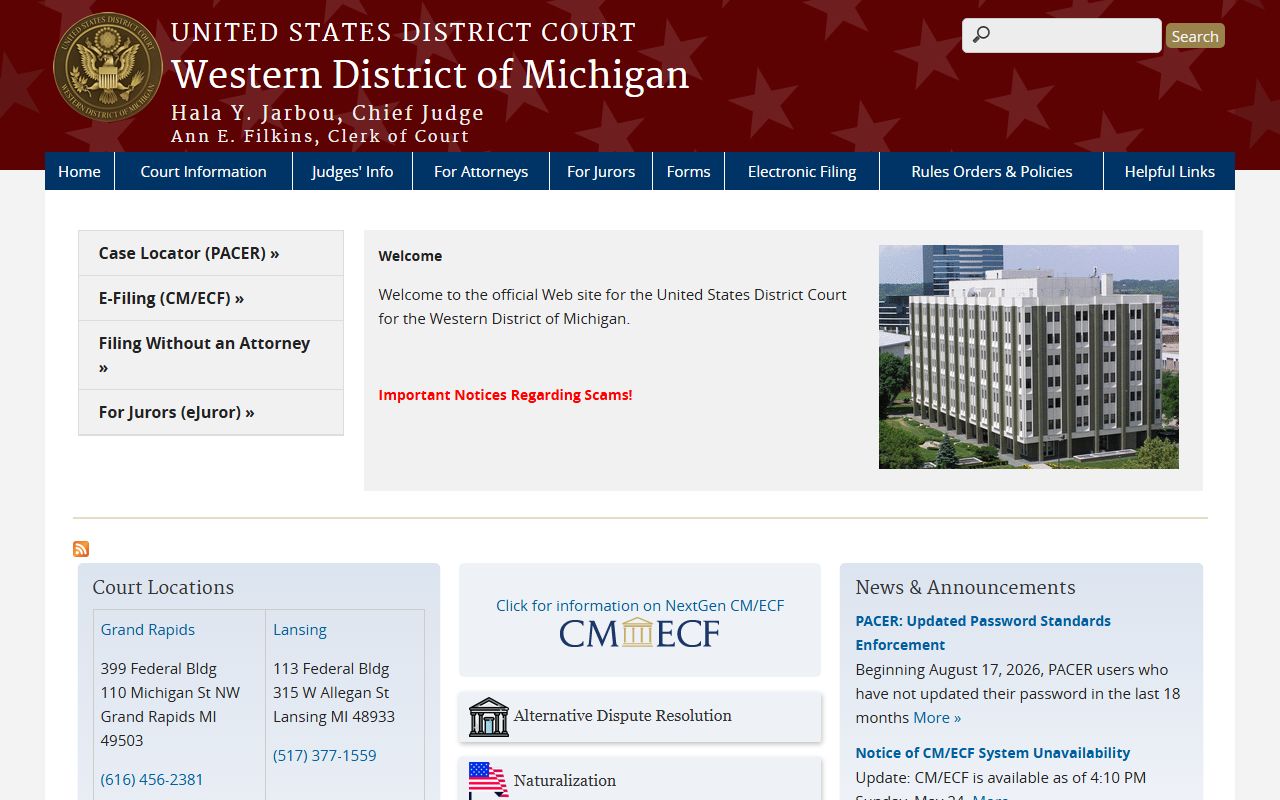
The federal court sits outside the county but still serves it, which is why an estate matter with a federal angle does not appear in the local probate index.
The district holds court in several cities. Its court locations page lists Grand Rapids, Kalamazoo, Lansing, and Marquette, with Grand Rapids as the headquarters.
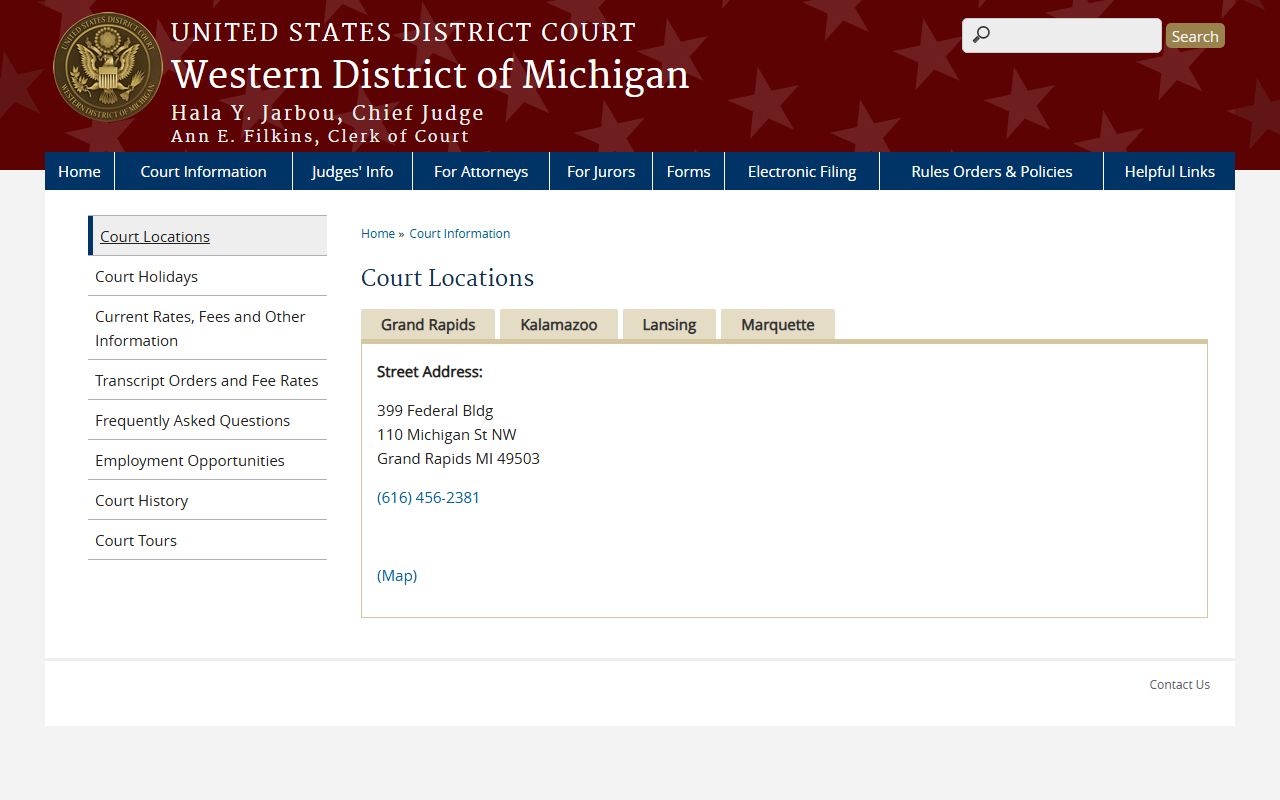
None of those courthouses sits in Grand Traverse County, so a federal filing from Traverse City is docketed at one of the district offices instead of the Suite 223 probate counter.
Federal filing runs on paper only at the front end for a few filers, but most documents move electronically. The district's electronic filing page explains how attorneys and parties submit documents online.
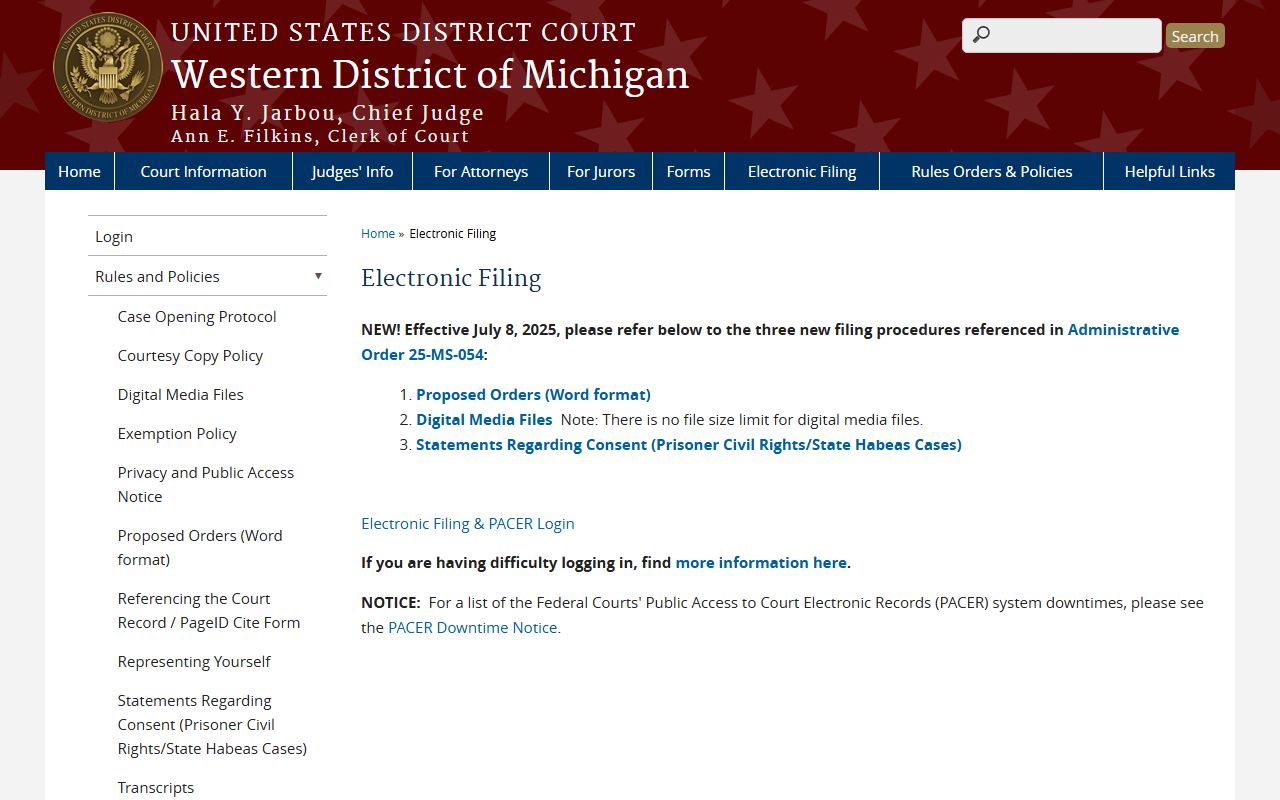
That system is separate from the county's probate process, and it feeds the federal case index rather than the local one.
Viewing federal documents takes an account. The district's CM/ECF login is the gateway, and a PACER account is required to open the filed papers.
For a normal Grand Traverse County estate, none of this applies, and the county Probate Court remains the office that holds the will, the letters of authority, and the estate file.