
How to Search Grand Traverse County Court Records
The county's public court search is split into two free portals. Circuit court civil cases live in one database, and felony criminal cases live in another. Both open from the county's Civil and Criminal Records Search page. The civil system holds full case information and a register of actions from 1986 to the present, with 1967 through 1985 as index only. The database updates nightly. The records office holds files back to April 26, 1859, and no ID is needed to search.
The county records hub shows exactly which links open each case type. A lead-in to the county's Civil and Criminal Records Search page shows how the two databases are labeled before you click through.
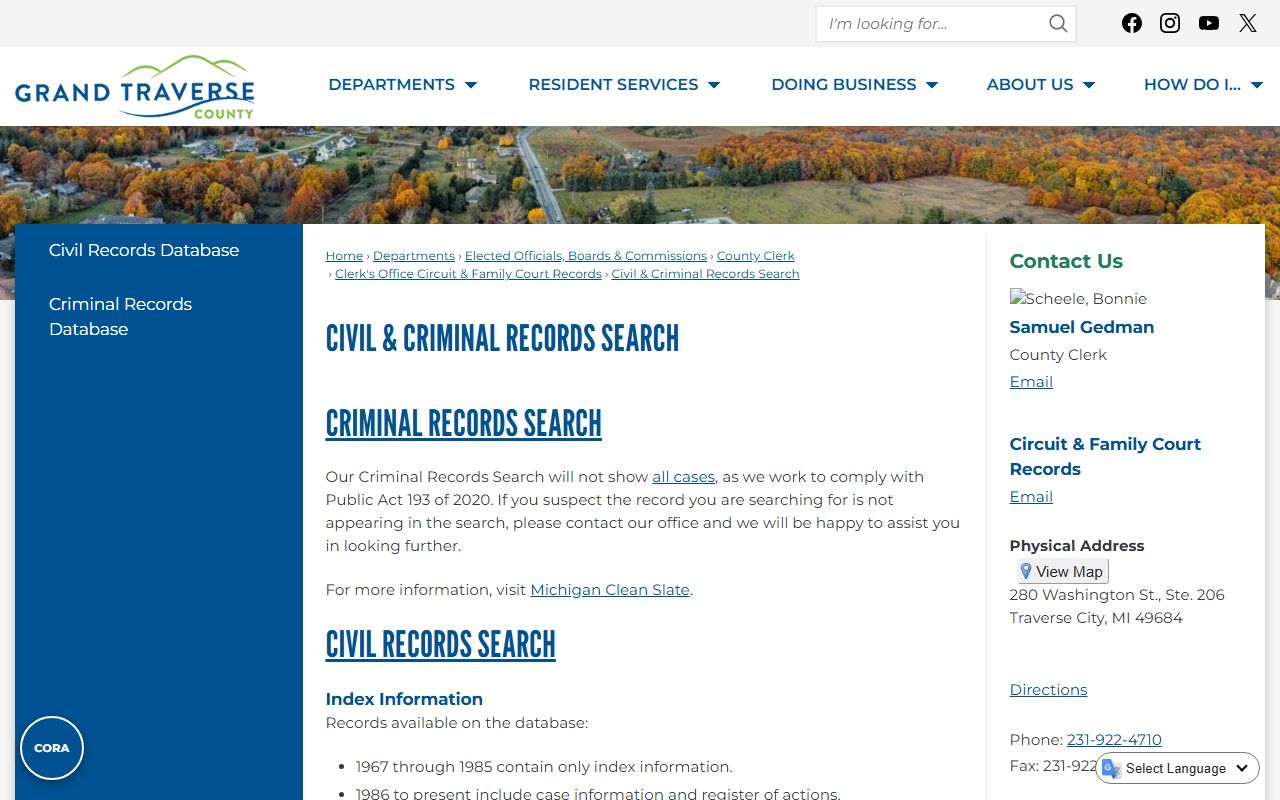
Reading the warning text there matters, because the criminal search will not show every case. Public Act 193 of 2020 and Michigan Clean Slate can remove qualifying records from public view. Before you start, decide whether the case is civil, a circuit felony, a district-court misdemeanor or ticket, or something protected like a personal protection order.
- Open the civil or criminal portal from the county's records search page.
- Enter a last name, a first name, or a case number. If you use a partial last name, leave the first name blank.
- Add the case year in ccyy format and pick a county from the dropdown.
- Submit the query and open the matching case to read the register of actions.
- Request a certified copy from the records office if you need one for legal use.
The civil case search form keeps the fields short and shared with the criminal system. The layout below shows the same name and case-number boxes that both portals use.
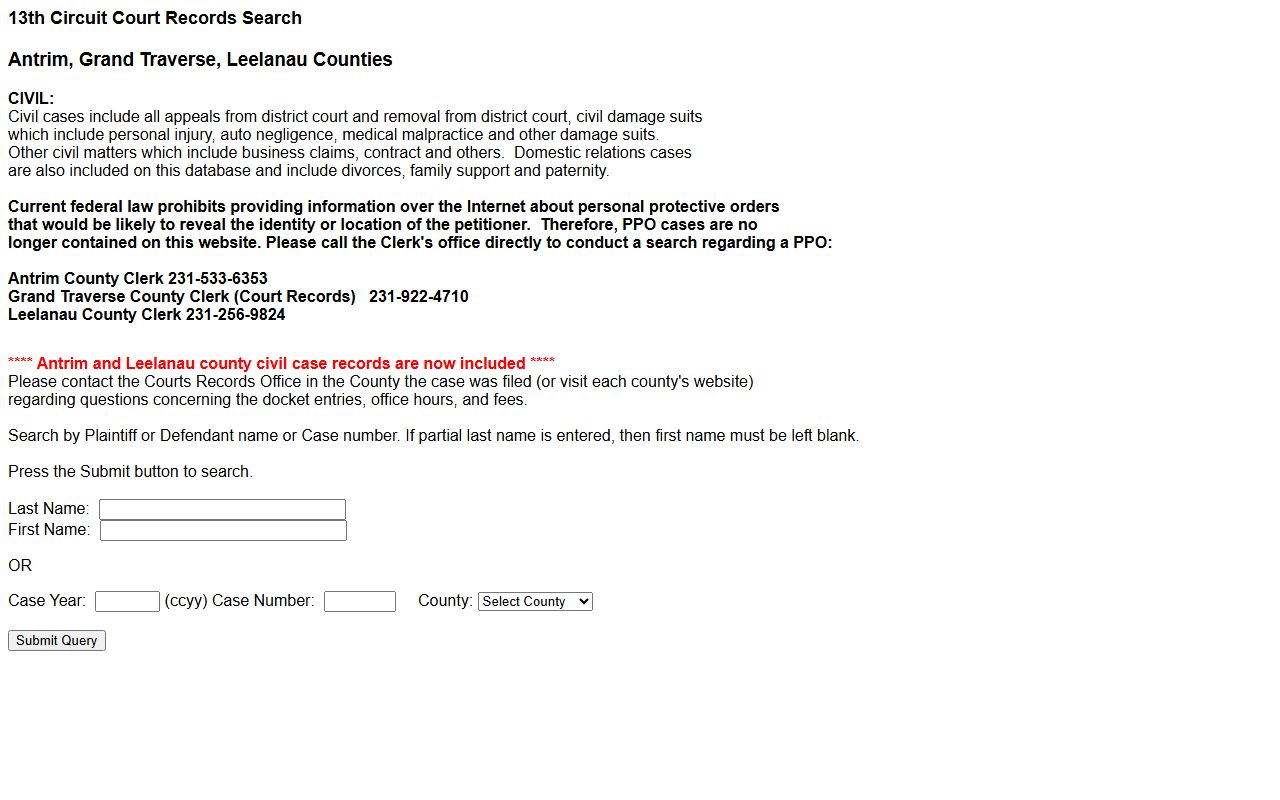
The county dropdown reaches beyond one county because the 86th District Court and shared records systems cover three counties.
| Field Label | Type | Required | Notes |
|---|---|---|---|
| Last Name | text | no | Partial last name allowed; leave first name blank if used. |
| First Name | text | no | Leave blank when using a partial last name. |
| Case Year | text | no | ccyy format. |
| Case Number | text | no | Use with case year or a name. |
| County | dropdown | yes | Select County, Antrim, Grand Traverse, Leelanau. |
| Submit Query | button | yes | Runs the search. |
Note: personal protection orders are not posted on the civil website and must be handled by phone with the clerk's records office.
The Grand Traverse County Judicial System
Michigan uses a layered court structure, and Grand Traverse County follows it. The Michigan Supreme Court sits at the top. Below it is the Michigan Court of Appeals. Under that are the trial courts that do the daily work. The 13th Circuit Court is the county's general trial court for felonies, civil suits over $25,000, and family matters. The 86th District Court handles misdemeanors, traffic, small claims, and arraignments. The Probate Court hears estates, guardianships, and mental-health cases.
The county's Courts hub gathers these venues in one place along with the Family Division, Friend of the Court, and Probation. The landing page shows how each court links to its own records and payment tools.
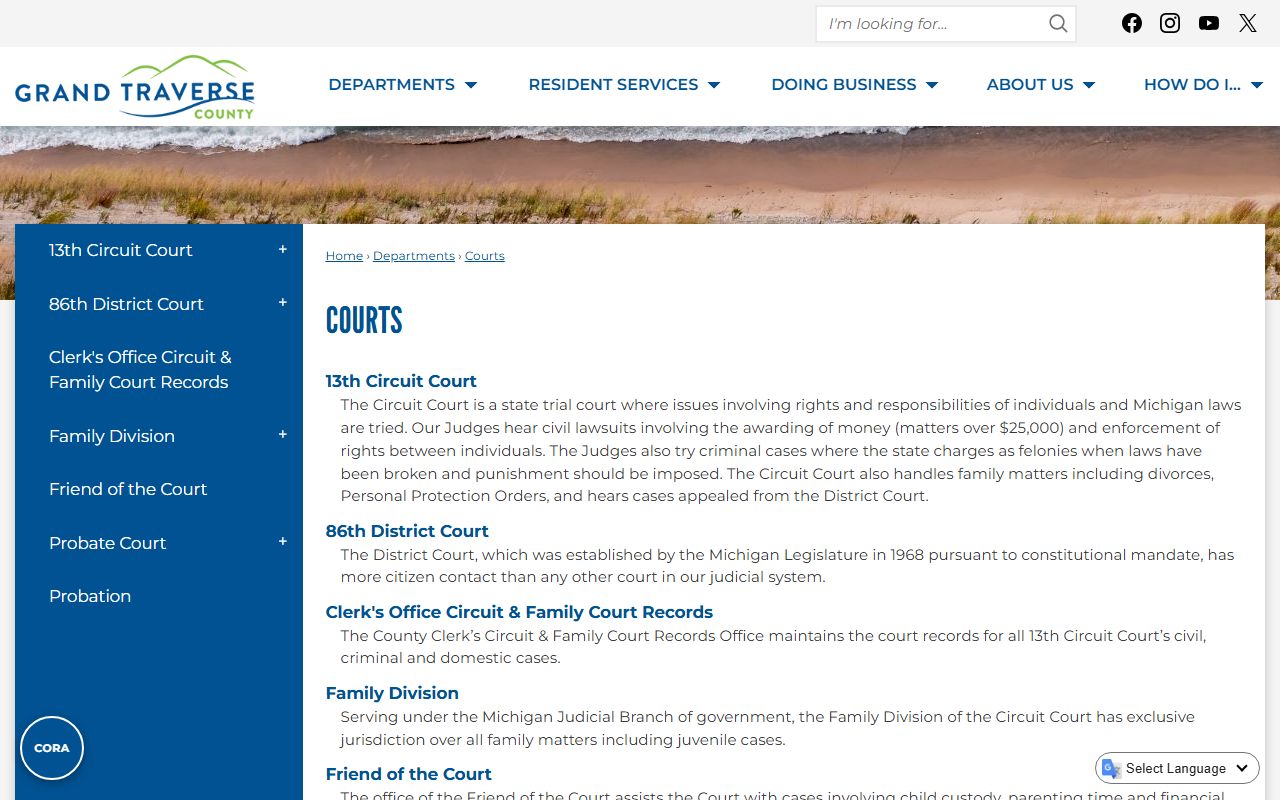
The district court is not a single building. The 86th District Court is a three-county operation covering Grand Traverse, Antrim, and Leelanau, with a Leelanau session in Suttons Bay. Judges Robert A. Cooney and Michael S. Stepka share the district bench, and Judge Cooney is chief judge.
Case flow: Michigan Supreme Court › Michigan Court of Appeals › 13th Circuit Court / 86th District Court / Probate Court
| Court | Jurisdiction | Case Types |
|---|---|---|
| 13th Circuit Court | General trial court | Felonies, civil over $25,000, divorce, appeals from district court |
| 86th District Court | Limited trial court | Misdemeanors, traffic and civil infractions, small claims, landlord-tenant |
| Probate Court | Probate and mental health | Wills, estates, guardianships, conservatorships, trusts, involuntary treatment |
Circuit, District, and Probate Courts Compared
Picking the right venue saves time, because each court holds its own records. The circuit court is where the largest civil suits and all felonies end up. The district court is the first stop for tickets, misdemeanors, and low-dollar civil claims. The probate court stands apart, handling estates and guardianships that the other two courts do not touch. The table sets the three side by side so a searcher can match a case to the right office.
| Feature | 13th Circuit Court | 86th District Court | Probate Court |
|---|---|---|---|
| Criminal reach | Felonies | Misdemeanors | None |
| Civil reach | Over $25,000 | Small claims, landlord-tenant | Estates and trusts |
| Records held by | County Clerk records office | District court office | Probate Court office |
| Online case search | Civil and felony portals | Calendar and payment tools | Office contact or file review |
Divorce records split across two of these courts. A divorce with minor children is kept by family court records, while a divorce without minor children is filed with the circuit civil records.
Grand Traverse County Courthouses
The county's court functions cluster along Washington Street in downtown Traverse City rather than sitting in one tower. The Robert P. Griffin Hall of Justice holds the district court, the circuit and family court records office, and the probate court. The jail and corrections office stand a few doors away, and a separate Historic Courthouse is preserved nearby. The clerk's Circuit and Family Court Records office is the core desk for circuit civil, criminal, and domestic files.
The records office page explains what the clerk keeps and how the family court records unit fits in. A quick look at that page shows the split between general civil records and family files created in 2001.
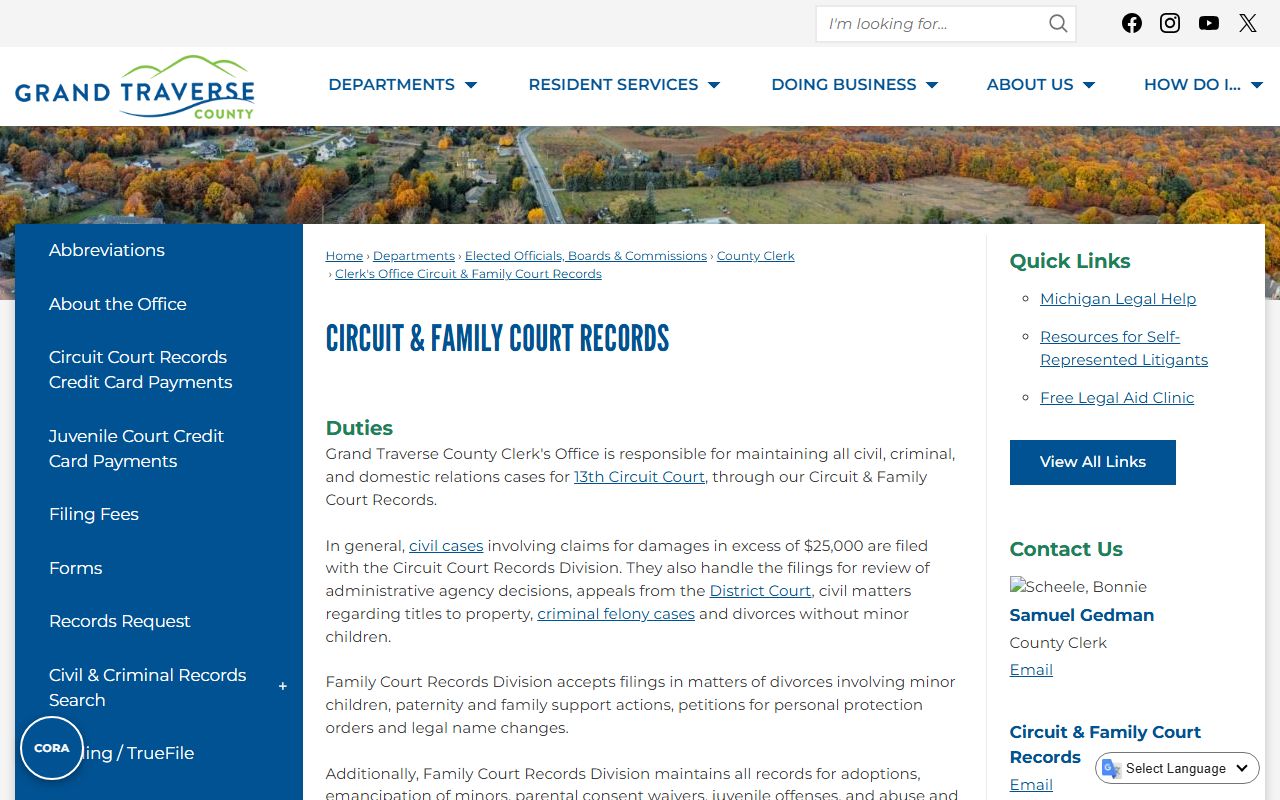
Each office keeps its own phone line and suite number, so it helps to confirm which desk holds the file before a visit. The cards below list the main record desks in the Washington Street corridor.
Circuit & Family Court Records
280 Washington Street, Suite 206
Traverse City, MI 49684
231-922-4710
Types of Court Records Available in Grand Traverse County
The county's court record universe covers several case families. Civil and felony circuit records are the most searchable online. Family and juvenile matters are partly public and partly restricted. Probate records are the least digitized and often need office contact. The county's Online Records hub gathers many of these indexes in one place.
That hub links marriage, civil and criminal cases, death records, parcel data, and deed indexes, and it notes that searches are free unless marked otherwise. The page below shows how broad the county's online index set has become.
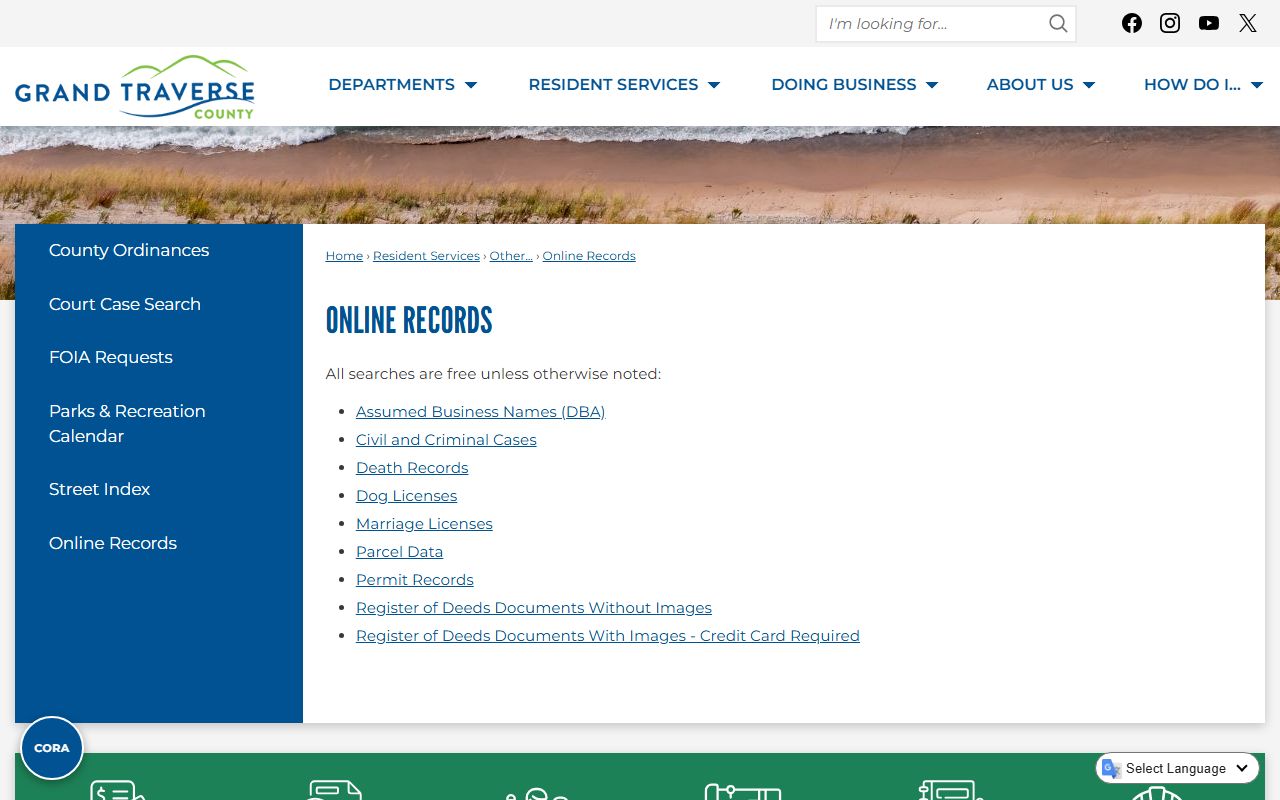
Criminal coverage is narrower than many people expect. The circuit criminal database includes only felonies bound over from district court, so misdemeanors do not appear there.
- Civil records - damage suits, contracts, business claims, and appeals from district court.
- Criminal records - felony cases in circuit court; misdemeanors stay with the district court.
- Family records - divorce with minor children, paternity, name changes, and protection orders.
- Probate records - wills, estates, guardianships, conservatorships, and trusts.
- Traffic records - civil infractions and citations handled by the district court traffic division.
The criminal case search uses the same name and case-number layout as the civil side. The felony-only form below is where circuit criminal files show their offense and sentencing detail.
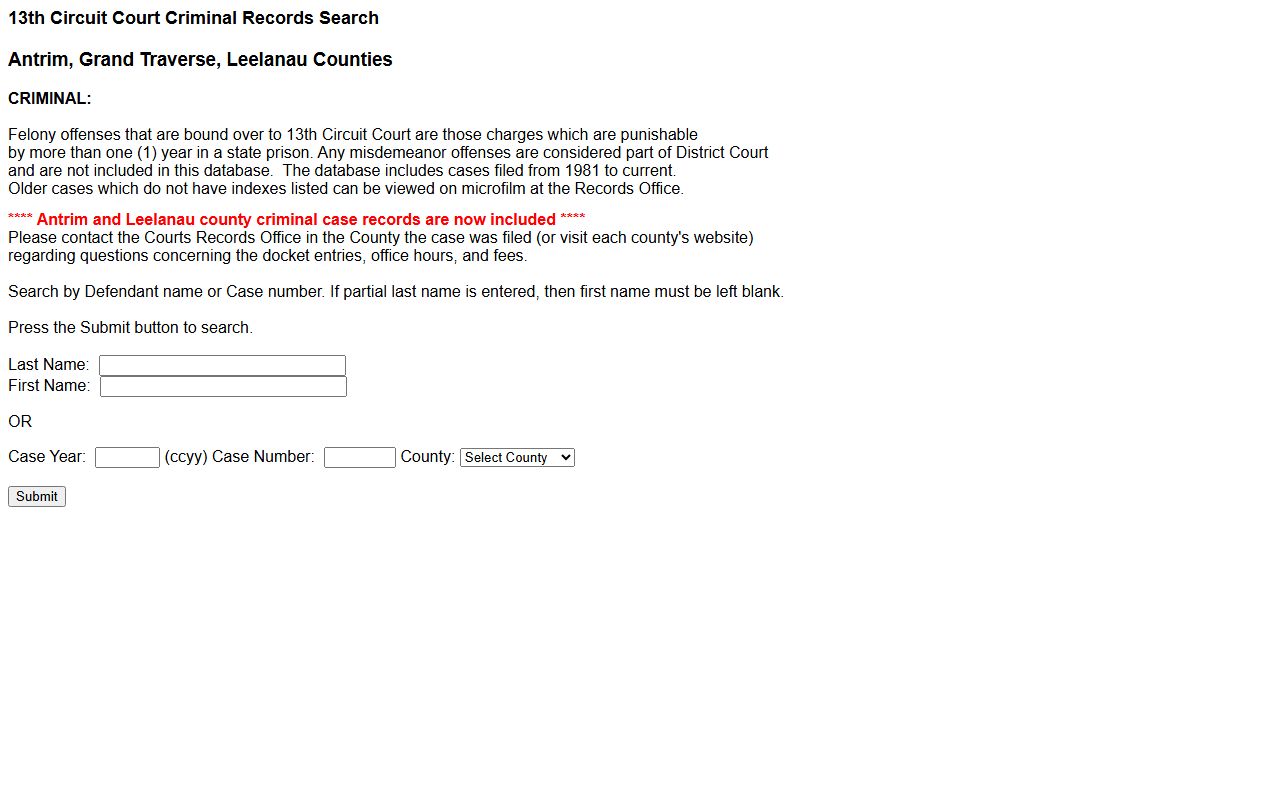
Older criminal cases without an index are viewable on microfilm at the records office.
What Grand Traverse County Court Records Show
A case record here reads like a timeline. The header names the parties and the judge, then the docket lists every filing in date order. Civil files show fees, service, hearings, motions, orders, and judgments. Criminal files add the offense, plea, conviction, and disposition. The county's Court Cases page points to the same databases where these fields appear.
A single case pulls together many small data points. The table lists the core fields a searcher meets first.
| Field | What It Shows |
|---|---|
| Case Number | The county database key plus the case-year and case-number structure. |
| Filing Date | When the case was opened, with closed, expired, and reopened dates as they apply. |
| Parties | Plaintiff, defendant, attorneys, alias, and the P-number identifier. |
| Charges / Cause | Offense, degree, description, and associated charge, or the civil cause of action. |
| Disposition | The final outcome, such as judgment, dismissal, or nolle prosequi. |
| Sentence / Judgment | Sentencing terms in criminal files or the money judgment in civil files. |
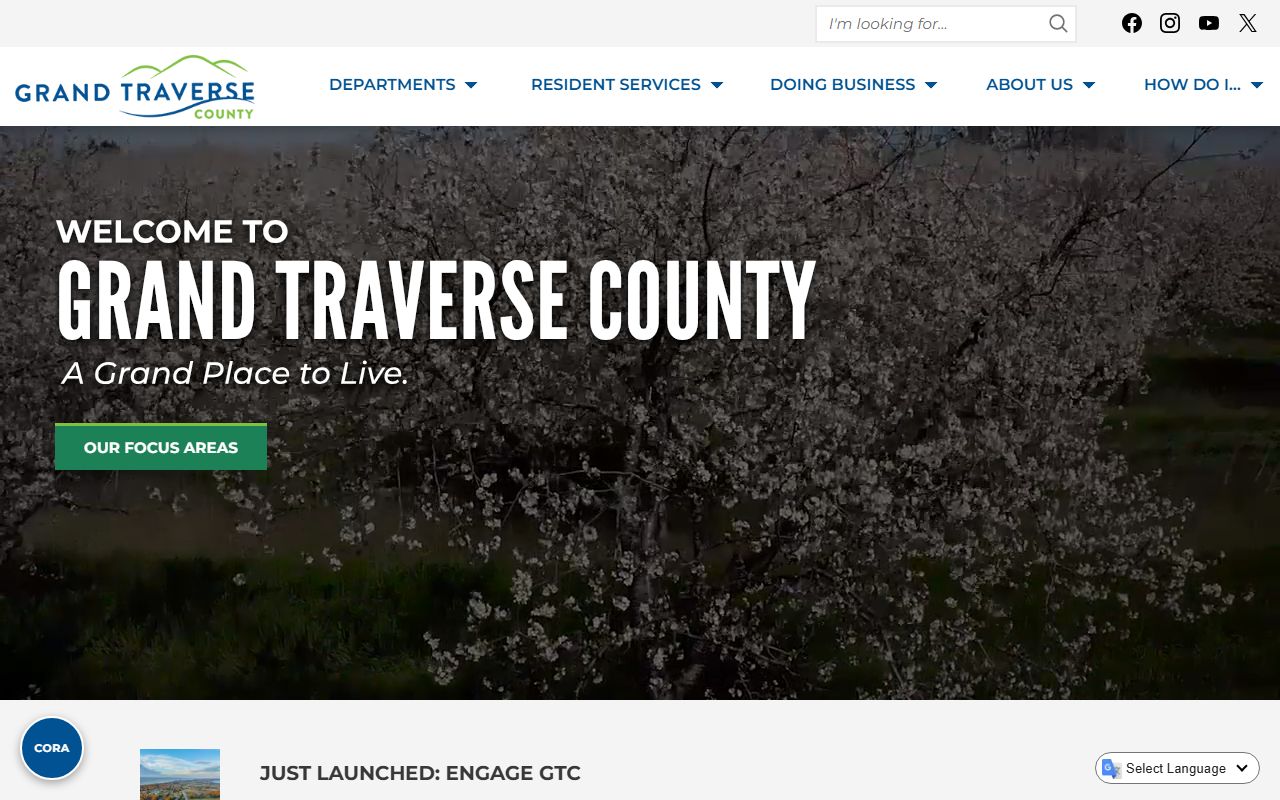
The county's county homepage ties these department pages together for anyone starting from scratch. The main portal shown here is a useful entry point when you do not yet know which court holds a file.
Some fields are removed before a file goes public. Personal protection orders drop off the online civil site, and certain probate filings require redacted copies.
Public Access Laws for Grand Traverse County Court Records
Michigan starts from a presumption that public records are open. What you can actually see still depends on the record type. Civil and most criminal circuit files are public, while protection orders, juvenile matters, and mental-health cases can be closed. State law and court rules set the boundaries, and the county follows them when it answers a request.
The statutes below shape how records are released, priced, and kept. Each one carries a plain-English point.
Key Statutes:
Michigan Code § 15.235 - Sets the request and fee rules a public body follows when it answers a FOIA request.
Michigan Code § 15.243 - Lists the exemptions that let an office withhold parts of a record.
Michigan Court Rule 8.119 - Governs how courts keep case files and give the public access to them.
Michigan Code § 600.1427 - Makes probate register records public except where law or a court order closes them.
Michigan Code § 780.621g - Automatically sets aside qualifying convictions so they stop appearing in public systems.
Michigan Code § 35.32 - Keeps military discharge records, such as the DD214, confidential.
Note: FOIA backs county-held records while Court Rule 8.119 backs court-file access, so a request may land with either the clerk or the court depending on the record.
Records That Are Restricted or Confidential
Not every file is open. Juvenile case records carry limited public access, and adoption files are held but never posted online. Mental-health commitment matters in probate court are narrower than ordinary civil records. Probate filings that contain a birth date, Social Security number, or account number must be filed in a redacted form.
Sealed and set-aside records follow their own path. Michigan's automatic set-aside and Clean Slate rules can pull a qualifying conviction out of public view, though the underlying state record still exists under law. To confirm a status, a person can check the Michigan State Police criminal-history output, the ICHAT name-based search, or the court of conviction. The county's clean-slate material offers plain-English guidance before someone files.
Personal protection orders sit in family court records but stay off the public civil site. A caller who needs one has to reach the clerk's records office by phone rather than the online portal.
Specialty Courts in Grand Traverse County
The county runs several problem-solving dockets alongside its regular courts. These programs blend supervision and treatment instead of a standard sentence, and county pages publish handbooks and application steps for each one. Two long-running programs anchor the set.
The Sobriety Court started in 2001 and is led by Judge Michael S. Stepka. It targets drunk-driving and recovery cases with a team that includes the judge, prosecutor, defense counsel, a probation officer, treatment providers, and drug-testing staff. The Domestic Violence Court, led by Judge Robert A. Cooney, runs a separate criminal-division docket for misdemeanor domestic-violence charges filed in Grand Traverse and Antrim counties.
Beyond those two, the county lists a Recovery Court, a Drug Court, a Community Outreach Court, and an Eviction Diversion Program. The prosecutor's office actively participates in the recovery docket.
Grand Traverse County Sheriff and Jail
The Grand Traverse County Sheriff's Office and its Corrections Division run the county jail and provide security to the courts. Sheriff Mike Shea, the county's 35th sheriff, leads the office at 851 Woodmere Avenue, while the Corrections Division and Grand Traverse County Correctional Facility sit at 320 Washington Street near the Hall of Justice. Jail staff also transport sentenced offenders to the Michigan Department of Corrections and serve local warrants.
The county does not publish a traditional public jail roster. For live custody status, the county points people to MI-VINE, a free and confidential 24-hour service. For deeper detail, the full Grand Traverse County inmate records guide covers the corrections office, deposits, and mail, and the warrant records page explains what to do when a bench warrant is issued for a missed court date.
Marriage, Divorce, and Probate Records
The County Clerk handles marriage licenses through the vital records desk, with a three-day waiting period after the online application and a ceremony window of 33 days. Certified marriage copies cost $15 for the first and $5 for each additional copy of the same record. Divorce case files live with the circuit and family court records, and a full walkthrough sits on the marriage and divorce records page. Estates, guardianships, and trusts run through the probate court, covered on the probate records page.
Probate paperwork uses terms many families meet for the first time. The short glossary below defines the ones that come up most.
- Testator
- The person who makes a will.
- Executor
- The person named to carry out a will, also called a personal representative.
- Conservator
- A person appointed to manage another person's money or property.
- Intestate
- Dying without a valid will, so state law decides who inherits.
Grand Traverse County Court Records Fees
Fees depend on how you get a record and how old it is. Searching the online portals is free. Copies cost more, and certified copies cost the most because a clerk certifies them for legal use. The county posts its copy pricing on the Circuit Court Records payment page.
That page also spells out how a certified copy is priced by page. The copy request workflow shown there mirrors the fee list below.
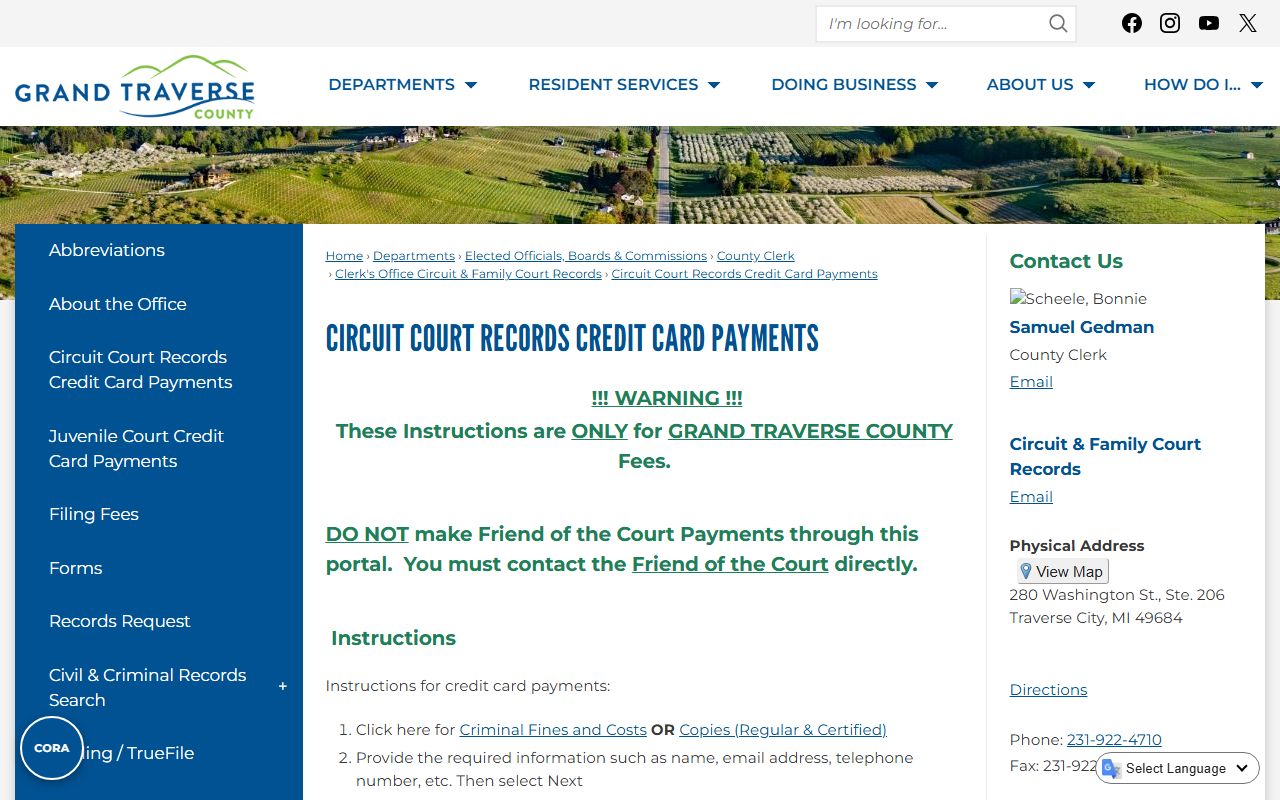
Public research terminals at the Hall of Justice are free to use, and copies made there run less than certified ones.
| Item | Amount |
|---|---|
| Plain copy per page (public terminal) | $0.50 |
| Certified copy | $10 plus $1 per page |
| Recent register of action | $3 |
| Register of action from 1994 or earlier | $10 |
| Civil e-filing system fee (new civil case) | $25 |
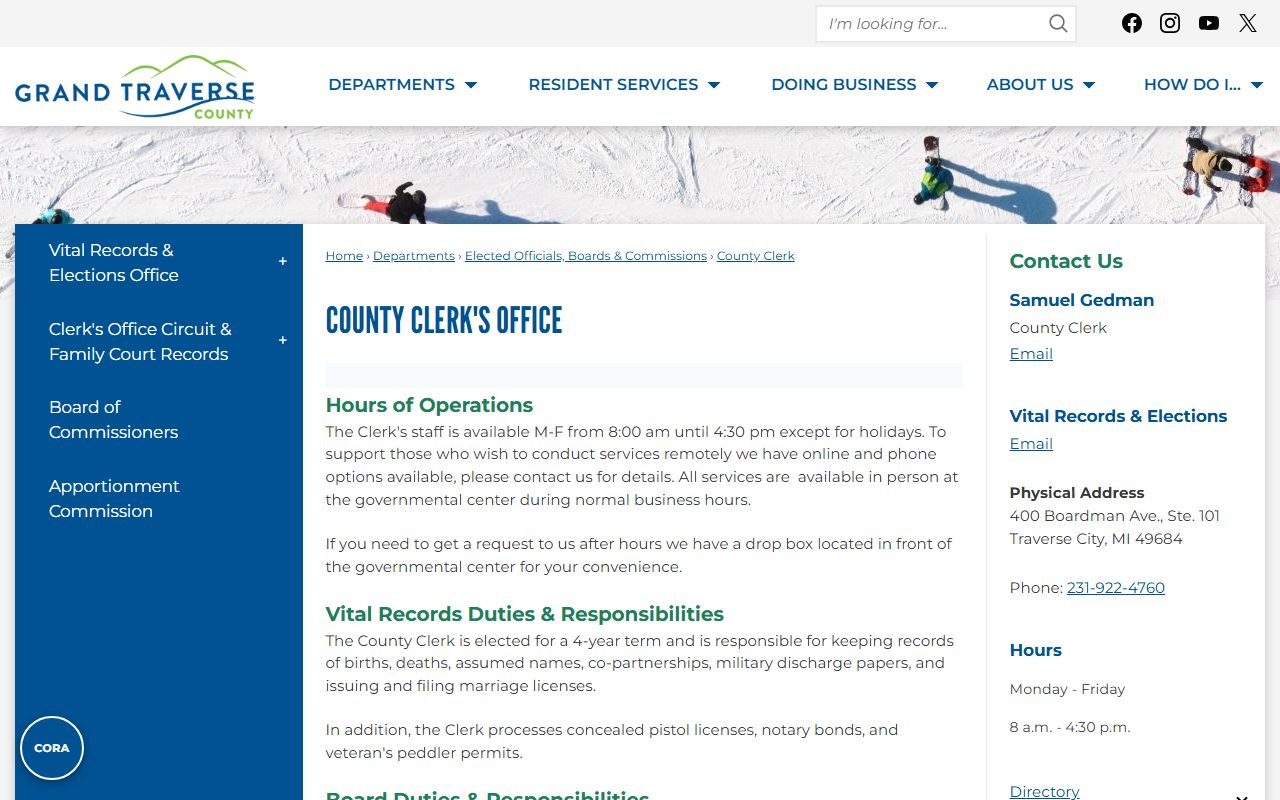
The County Clerk office collects these fees by cash, check, money order, or card in the contexts it lists. The clerk office page also shows the vital records and election duties the same office carries.
When a record is not online, the county's Records Request page is the fallback. The request page below accepts mail, an email or online form, and in-person visits.
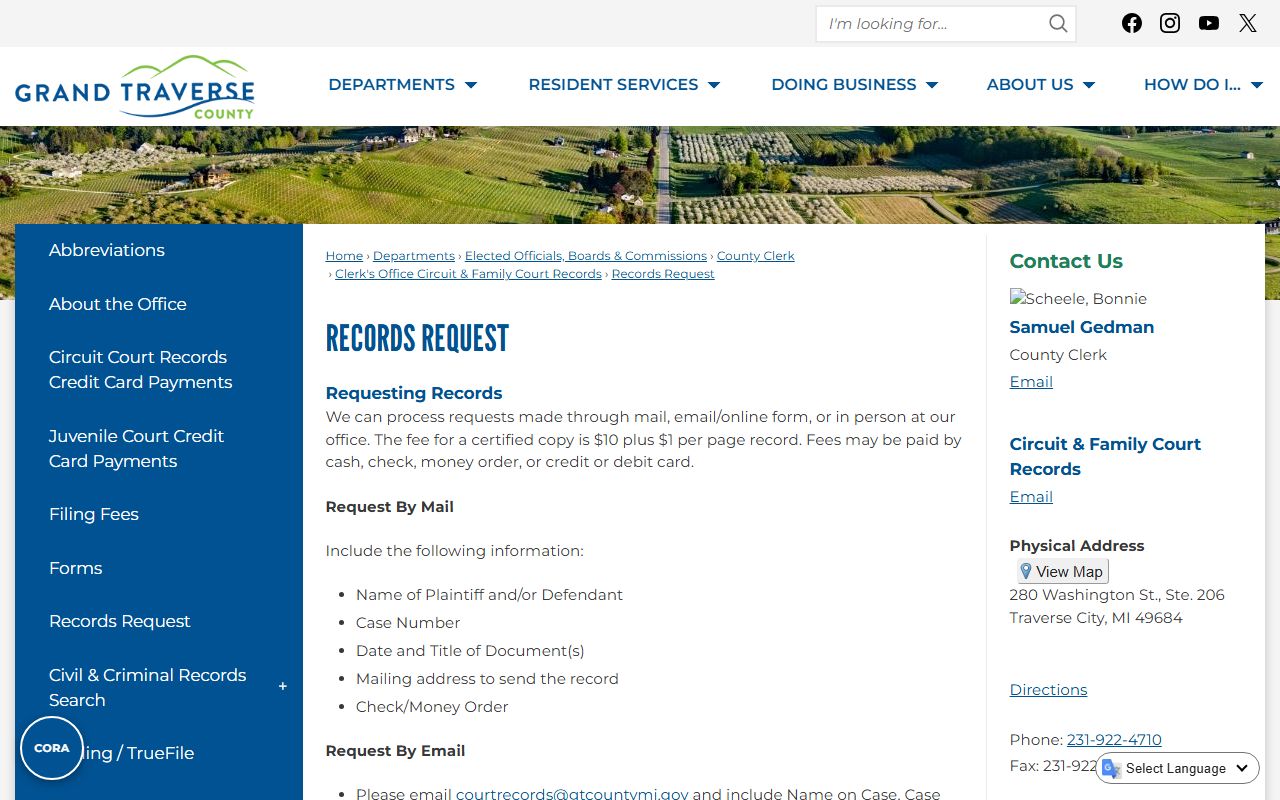
A mail request should name the plaintiff or defendant, the case number, and the title and date of the document.
How to Interpret Grand Traverse County Court Records
Docket language can look dense at first. A charge is not the same as a conviction, and a disposition tells you how the case actually ended. A bindover means the case moved from district court up to circuit court. An information is the prosecutor's formal charging document, and nolle prosequi means the prosecutor dropped the charge.
Civil files carry their own vocabulary. A judgment sets who won and what is owed, a garnishment collects against wages, and a satisfied judgment shows the debt was paid. When a docket says a case was dismissed with prejudice, it cannot be refiled, while dismissed without prejudice leaves the door open. Reading the disposition and the final order together gives the clearest picture of a case.
Accuracy and Record Limitations
Online records lag real life by design. The civil database updates nightly, so a filing made today may not appear until tomorrow. Older files can sit off-site or on microfilm, and some categories never go online at all. When a detail matters for a legal decision, confirm it against the certified file.
Note: Verify any case detail with the originating court or the clerk's records office before relying on it, since online indexes can lag, omit sealed cases, or hold an entry error.
History of Grand Traverse County Courts
Grand Traverse County was organized under Michigan's county framework in 1851, the same year its first sheriff took office. The county's records office holds files back to 1859, and its historic-photo pages show a courthouse lineage across several eras. A separate Historic Courthouse at 328 Washington Street keeps that older building present in the downtown justice district.
The modern lower court arrived in 1968, when the Michigan Legislature created the district court system by constitutional mandate. More recent milestones include a 2013 move to electronic search-warrant processing and video hearings, and a 2024 push to plan a new justice-facility complex. That planning shows the county's court campus is still changing.
Frequently Asked Questions
Where do I search Grand Traverse County court records online?
Start at the county's Civil and Criminal Records Search page. It opens two free portals, one for circuit civil cases and one for felony criminal cases. Search by a party name or a case number, and pick a county from the dropdown. The civil database holds full case detail from 1986 forward and updates nightly.
Why is a criminal case missing from the search?
The circuit criminal portal shows felonies only, so misdemeanors never appear there. On top of that, Public Act 193 of 2020 and Michigan Clean Slate can remove qualifying convictions from public view. If a record is missing, the county points you to the district court for misdemeanors and to the state's set-aside resources for sealed cases.
How do I get a certified copy of a court record?
Ask the clerk's records office at the Hall of Justice. A certified copy costs $10 plus $1 per page, while a plain copy at the public terminal is $0.50 per page. You can request one by mail, by email or online form, or in person. Cash, check, money order, and card are accepted in the contexts the county lists.
Which court handles my case?
It depends on the case type. Felonies and civil suits over $25,000 go to the 13th Circuit Court. Misdemeanors, traffic tickets, and small claims go to the 86th District Court. Estates, guardianships, and trusts go to the Probate Court. Knowing the venue tells you which office and which search tool to use.
How do I check if someone is in the county jail?
The county does not post a public jail roster. For custody status, use MI-VINE, the free and confidential 24-hour notification service the county recommends. You can also call the Corrections Division, and the prosecutor's office can share case-status updates for a pending matter.
Are personal protection orders in the online search?
No. Personal protection orders are kept in family court records but are held off the public civil website. To ask about one, call the clerk's records office directly rather than using the online portal. Juvenile and adoption files are also restricted and stay offline.