
Grand Traverse County Circuit Court Overview
Grand Traverse County sits in Michigan's 13th Circuit. The 13th Circuit Court is the county's general-jurisdiction trial court, which means it can hear the widest range of cases. Its docket covers felony criminal charges, civil suits above $25,000, family and domestic matters, and appeals that come up from the District Court. The county clerk serves as clerk of this court and keeps its records through the Circuit and Family Court Records office.
Michigan's court structure runs in layers. The Michigan Supreme Court sits at the top, the Michigan Court of Appeals sits below it, and the trial courts sit at the base. In this county the trial layer is made of three parts. The 13th Circuit Court handles the heavy civil and felony work. The 86th District Court handles misdemeanors, traffic, and smaller civil claims. The Probate Court handles estates and guardianship. Each part keeps its own files.
The clerk's records office holds circuit files dating back to April 26, 1859. No photo ID is required to view them.
Grand Traverse County Court Table
The county's trial courts share a single justice campus on Washington Street, yet each one answers a different phone line and handles a different case type. The 86th District Court is a three-county district covering Grand Traverse, Antrim, and Leelanau, so it also holds sessions outside Traverse City. The table below lists each court, where it sits, its main number, and what it handles.
| Court | Address | Phone | What It Handles |
|---|---|---|---|
| 13th Circuit Court / Circuit & Family Court Records | 280 Washington St., Ste. 206, Traverse City, MI 49684 | 231-922-4710 | Felonies, civil over $25,000, family and domestic, appeals from district court |
| 86th District Court | 280 Washington St., Traverse City, MI 49684 | 231-922-4580 | Misdemeanors, traffic and civil infractions, small claims, landlord-tenant, arraignments |
| Probate Court | 280 Washington St., Ste. 223, Traverse City, MI 49684 | 231-922-6862 | Estates, wills, guardianship, conservatorship, mental-health treatment |
| 86th District Court, Leelanau venue | 8527 E. Government Center Dr., Suttons Bay, MI 49682 | 231-256-8250 | District-court matters arising in Leelanau County |
| 86th District Court, Antrim venue | Antrim County | 231-533-6441 | District-court matters arising in Antrim County |
Judge Robert A. Cooney is chief judge of the 86th District Court, and Judge Michael S. Stepka also sits on that bench. The pair hold court in Traverse City every weekday, with Antrim and Leelanau sessions on Wednesday. The county calendar page links to public Michigan court-display pages for each judge and each county assignment.
How a Case Moves Through the Grand Traverse County Courts
A case does not stay in one court from start to finish. A felony begins in the District Court, then moves up to the Circuit Court once a judge finds enough evidence to proceed. A civil suit stays in one court but passes through set stages. The two flows below trace the usual path for each.
Criminal flow: Arrest › District Court arraignment › Preliminary exam / Bindover › Circuit Court arraignment › Pretrial › Trial › Sentencing › Michigan Court of Appeals
Civil flow: Complaint filed › Answer › Discovery › Motions › Trial › Judgment › Court of Appeals
Several of these steps use terms that trip up first-time readers. A short glossary helps.
- Arraignment
- The first court appearance where the charge is read and a plea is entered.
- Preliminary exam
- A District Court hearing that tests whether a felony has enough proof to go forward.
- Bindover
- The transfer of a felony from the District Court up to the Circuit Court.
- Disposition
- The final outcome of a case, such as a verdict, plea, or dismissal.
Circuit Court vs. District Court vs. Probate Court
Michigan gives each trial court a defined lane. The Circuit Court takes the serious and the large. The District Court takes the routine and the small. The Probate Court takes estates, guardianship, and mental-health matters. The comparison below shows where the lines fall so a records search lands at the right counter.
| Circuit Court | District Court | Probate Court | |
|---|---|---|---|
| Civil Jurisdiction | Civil over $25,000, title to property, appeals from district court | Civil up to $25,000, small claims, landlord-tenant | Estates, trusts, and related petitions |
| Criminal Jurisdiction | Felonies | Misdemeanors, civil infractions, traffic | None |
| Family Cases | Divorce, custody, support, PPOs, juvenile, paternity, adoption | None | Guardianship, conservatorship, mental-health treatment |
| Appeals Path | Michigan Court of Appeals | Circuit Court | Circuit Court, then Court of Appeals |
Notice the appeals column. A person unhappy with a District Court ruling appeals to the Circuit Court, not to a higher state court first. From the Circuit Court, an appeal moves to the Michigan Court of Appeals, and from there to the Michigan Supreme Court. There is no "county court" or justice of the peace in this system. Michigan retired those names long ago.
The Family Division and Friend of the Court
The Family Division sits inside the Circuit Court and handles the county's domestic and juvenile caseload. The county created its family court records office in 2001 to gather these files in one place. The division hears divorce with minor children, family support, paternity, name changes, personal protection orders, juvenile offenses, adoption, and neglect or abuse cases. Some of these files are open, and some are sealed by law.
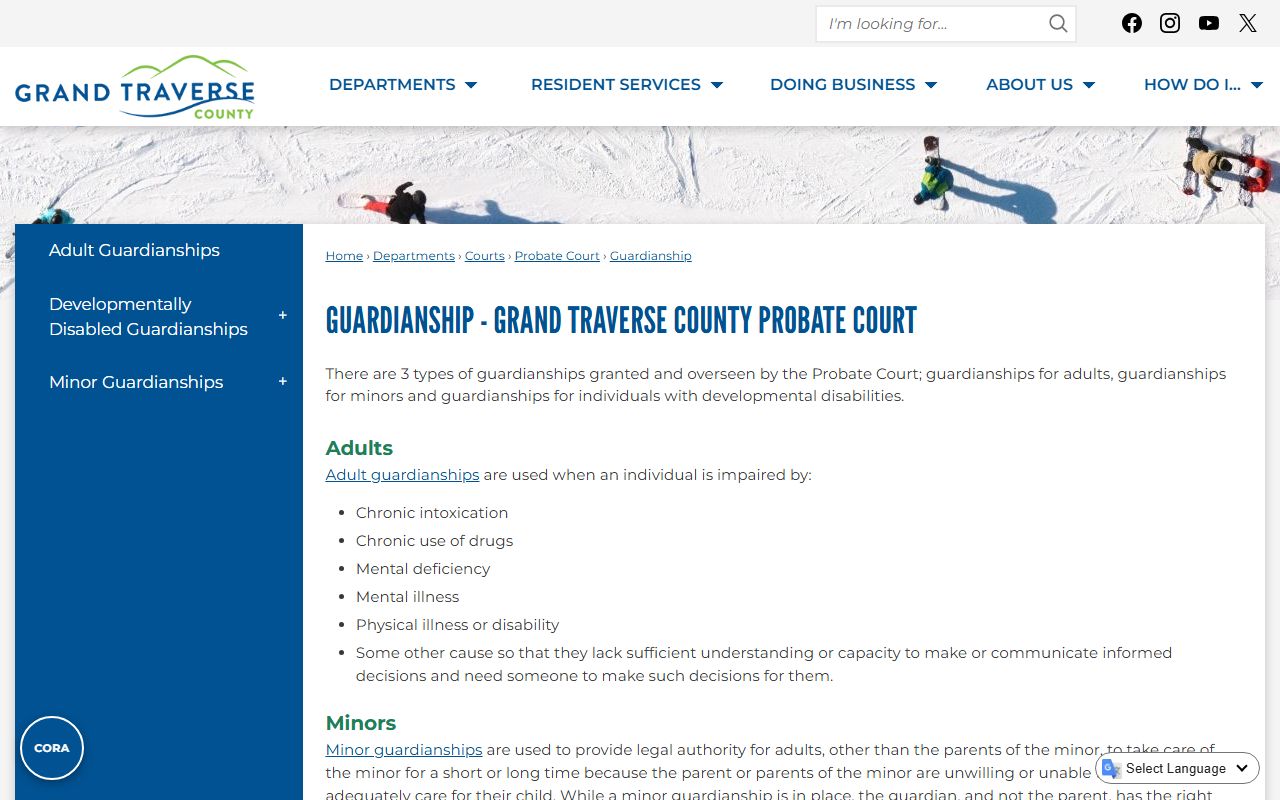
Guardianship of a minor can begin in the Family Division or in the Probate Court, depending on the case. The county's Guardianship page walks through adult, minor, and developmental-disability options.
The Friend of the Court is a Family Division office that supports child custody, parenting time, and support orders. It investigates disputes, enforces support, and keeps the payment record for many domestic cases. Its files often sit alongside the divorce record, so a custody search may touch both offices.
Note: Personal protection orders are kept out of the public online search, so a PPO record must be handled by phone with the county clerk's office.
Estates and Wills at the Probate Court
The Probate Court runs on the same campus and shares the trial-court structure, yet its subject matter is distinct. It handles decedent estates, guardianship, conservatorship, trust matters, and involuntary mental-health treatment. When a person dies, the estate case opens here, whether the family chooses an informal or a formal probate path.
The county's Decedent Estates page lays out both routes and the filing fees for each.
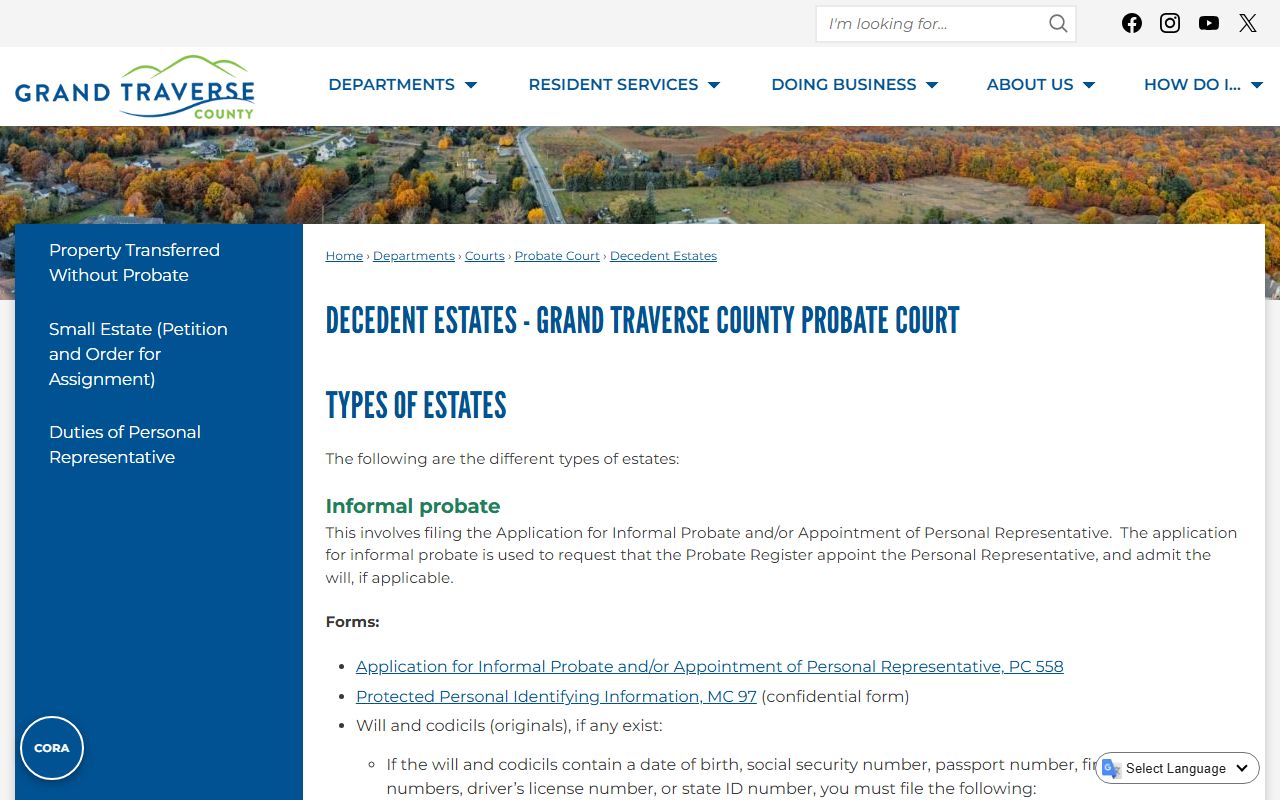
An estate filing, informal or formal, costs $175 to open. Certified Letters of Authority run $12 each, a small-estate filing is $25, and a certified court order is $11. The probate office does not take credit cards, so payment comes by cash, check, or money order.
The court also safekeeps original wills. A person can deposit a will with the Probate Court for storage during their lifetime, then withdraw or redeposit it later. The county's Wills page explains the deposit and redeposit process.
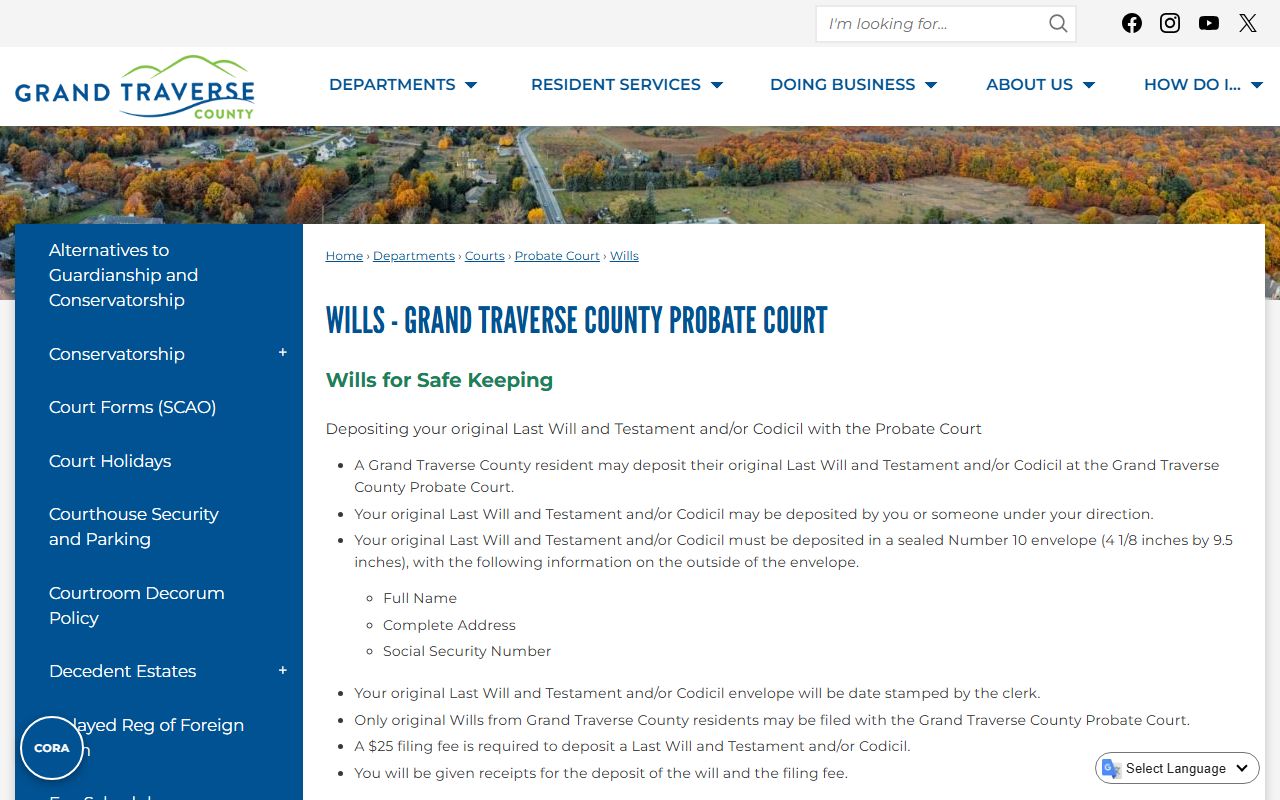
Redepositing a will costs $25. Storing the original with the court keeps it safe and gives the family a known place to find it when the estate opens.
Specialty Courts in Grand Traverse County
The trial courts run several problem-solving dockets that focus on treatment and supervision rather than jail alone. These programs pair a judge with prosecutors, defense counsel, probation officers, and treatment providers. They aim to break the cycle that sends the same people back to court.
- Domestic Violence Court, a criminal-division docket presided over by Judge Cooney.
- Sobriety Court, started in 2001, presided over by Judge Stepka.
- Recovery Court, an intensive treatment program in which the prosecutor's office takes part.
- Drug Court, with its own published handbook and program pages.
- Community Outreach Court, listed under the district court's services.
- Eviction Diversion Program, aimed at keeping tenants housed.
The Sobriety Court handbook describes a full team approach. The team includes the judge, prosecutor, defense counsel, probation officer, treatment providers, program graduates, drug-testing staff, law enforcement, and the participant. That structure is common across the county's treatment dockets.
Setting Aside a Conviction
A conviction does not always stay on the public record forever. Michigan law lets qualifying offenses be set aside, which removes them from the public court systems. The Circuit and District courts both play a part, since the court that entered the conviction is the court that acts on the set-aside.
The state's clean-slate program can clear some records without any filing at all. The county's Automatic Set-Asides page describes the public search routes and the fees involved.
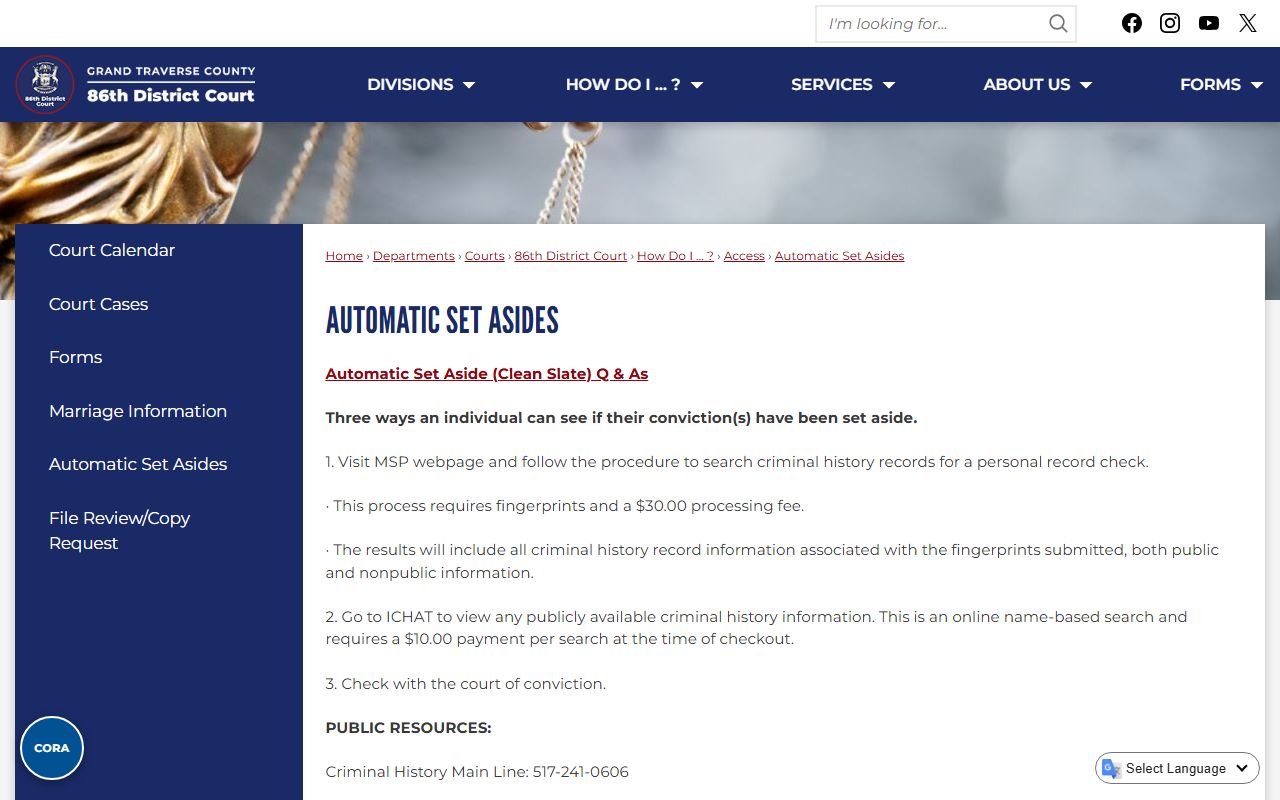
The automatic set-aside statute, MCL 780.621g, clears certain offenses on a schedule. The procedures in MCL 780.623 set the limits on how many and which convictions qualify. Because the criminal search already omits some cases under a 2020 public act, a missing result does not always mean a clean record. A person who needs a full history should confirm status with the clerk.
The Robert P. Griffin Hall of Justice
The county's court functions cluster on Washington Street in downtown Traverse City. The Hall of Justice houses the Circuit and Family Court Records office, the 86th District Court, and the Probate Court, while the jail and corrections office sit just up the block. A separate Historic Courthouse stands nearby and is kept as its own county facility.
The main public court address, and the front door for circuit records, is the Circuit and Family Court Records office. Its contact block is below.
Circuit & Family Court Records
280 Washington Street, Suite 206
Traverse City, MI 49684
231-922-4710
Fax: 231-922-4647
courtrecords@gtcountymi.gov
Certified copies of a circuit file cost $10 plus $1 per page. Plain copies from the public research terminal are $0.50 per page, and the terminals are free to use. A recent register of action is $3, while a register from 1994 or earlier is $10. The clerk also runs the Grand Traverse County Clerk office, which keeps vital records and issues certified copies through the same building.
Court Services and the Corrections Division
The Corrections Division does more than run the jail. Its staff provide court services, bailiffs, and security to every county court, so the same office that books an inmate also keeps order in the courtroom. The division sits at 320 Washington Street, a short walk from the Hall of Justice.
The county's Corrections Division page describes the jail address, the court-services role, and the transport duties.
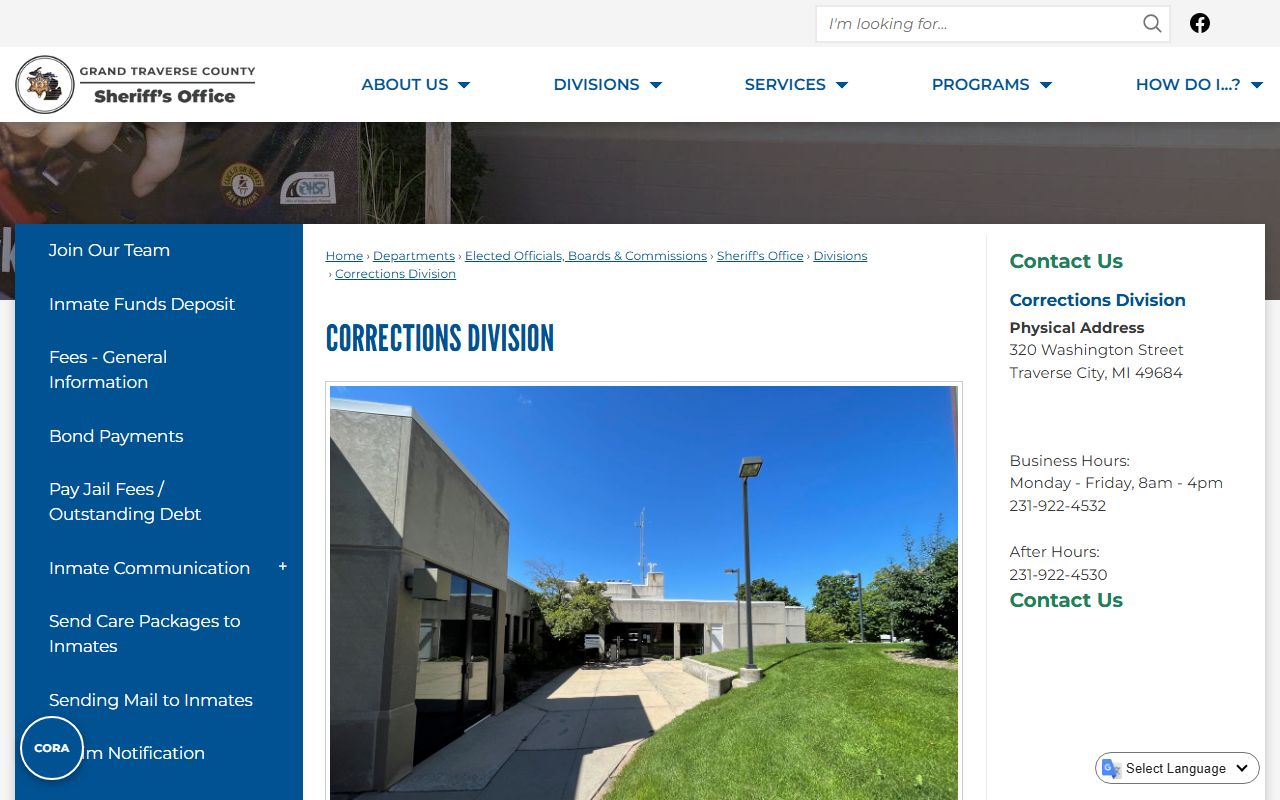
Jail staff also handle long-distance transports. They deliver sentenced offenders to the Michigan Department of Corrections and pick up people arrested on local warrants or court orders. The Grand Traverse County Correctional Facility follows MDOC, Federal Bureau of Prisons, ACA, and NCCHC standards for its operations and reentry programs.
History of the Grand Traverse County Courts
Grand Traverse County was organized in 1851, and its first sheriff, William H. Case, served from 1851 to 1853. The county's historic photo pages show a long courthouse lineage, with images labeled for summer and winter courthouses from as far back as 1905. The court system has passed through several buildings, not one static home.
The modern 86th District Court has a clean start date. The Michigan Legislature established the district courts in 1968 under a constitutional mandate. The Circuit Court's reach shows up in the county's Duck Lake record. A 2017 circuit order reaffirmed a high lake level first set in 1959, which is a lasting example of the court's role in local land and water disputes.
The county keeps modernizing. In 2013 the court began using tablets to process search warrants and expanded video hearings, including arraignments for defendants held in the state prison system. In 2024 a Justice Facility Advisory Committee began planning a new justice complex, a sign that the current campus is still evolving.
Notable milestones in the county's court history include the following.
- 1851, the county and its sheriff era begin.
- 1959 and 2017, the Duck Lake circuit orders.
- 1968, the district court is established.
- 2013, electronic search warrants and more video hearings.
- 2024, justice-facility planning begins.